

The Difference Between Hearing Voices and Believing Them: A Call for Trauma-Informed Mental Health Care

Recovery begins when we learn to observe our thoughts without becoming them.
Here is the thing… I hear voices, partly through auditory flashbacks and spirit communication (yes, I was a medium who had good clarification and feedback when I was working as one). But do you know the thing that sets me apart from schizophrenia? I detach from them and do not accept them as a belief - when I am hypervigilant they get stronger hence why I am now on a coffee detox.
When one becomes hypervigilant, we focus more on the threat than anything else in the environment. Like the saying goes… where awareness goes energy flows… But clinical science says, there is not enough evidence to conclude what schizophrenia is…. Now I have been going down the psychology and neuroscience rabbit hole for the past two years now - question after question - there appears to be a missing link, a one I believe is consciousness. When the mind goes quiet in meditation or in freeze mode, such as thought extraction or dissociation, it makes us more conscious and aware of our internal world. It is believed to be the awareness behind the thoughts and it is throughout your whole body. But our brain compoments are activated by thoughts which can direct the human body, take for example the placebo effect.
As I said, consciousness runs throughout the body and it has the potential to pick up things without out cognitive awareness.. this explains the gut feeling we have when we know something bad is going to happen. Neuroscience and psychology are still unaware as to what actually causes our thoughts - there are theories but science does not know for sure exactly. So if a person has extracted their own thoughts, they could be potentially leaving their consciousness open for other consciousness energies to connect. A 2025 .
review reported that approximately 30–50% of individuals with schizophrenia experience clinically significant dissociative symptoms, including depersonalisation, derealisation, amnesia, and detachment (Mansour R, 2025).
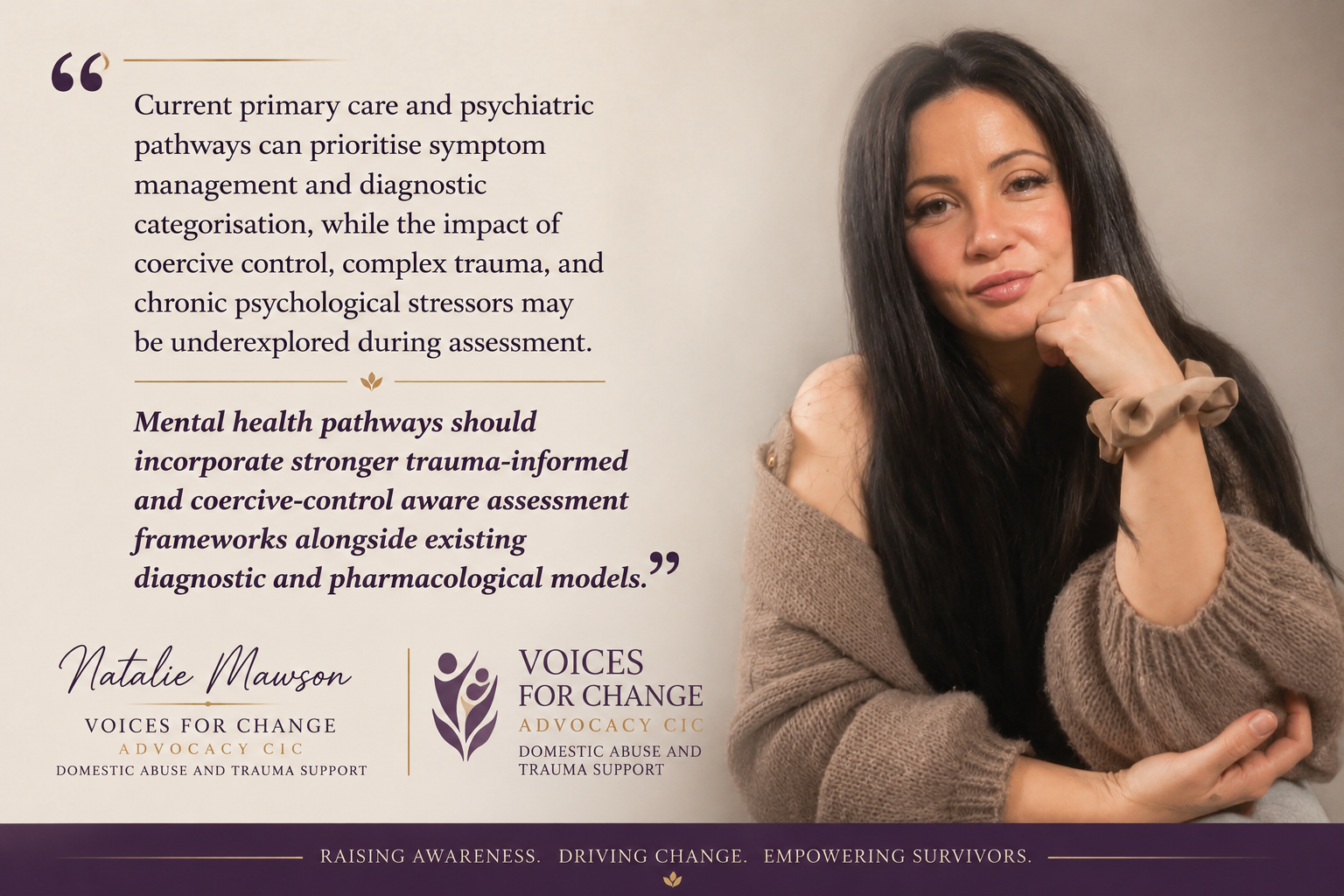
Why Trauma-Informed is Essential and UK Services Need to Understand Not Everything Can Be Evidenced
There is not going to be evidence for the above in science because we as scientists find it so hard to measure neurons, so we try to make sense by using rats. However, even with these advanced methods, scientists are not measuring every neuron in a brain simultaneously. For example, the human brain contains roughly 86 billion neurons, and even in small animals researchers usually record only a tiny fraction of the total neural activity. This is one reason why neuroscience remains challenging. We can observe neural activity and find correlations between brain activity and behaviour, emotions, memories, or trauma responses, but we still don’t have a complete picture of how complex experiences emerge from billions of interacting neurons.
When holistic treatments change behaviour and thoughts by releasing the trauma that was trapping the person by being able to change their belief attached to the voice from their body and mind. We can begin to help them change the beliefs attached to the voice hearing and reduce the hypervigilance attached to the expanded awareness on the voice hearing.
Behaviours of schizophrenics according to the DSM 5 - which are also symptoms of hypervigilance are;
Holding beliefs that others find unusual or difficult to understand (sometimes called delusions).
Becoming withdrawn from friends, family, or activities.
Appearing suspicious or fearful of others.
Having difficulty concentrating or following conversations.
Speaking in ways that seem disorganised or hard for others to follow.
Showing reduced emotional expression or appearing emotionally flat.
Neglecting self-care when unwell. Having changes in sleep, motivation, or daily functioning.
If we could help schizophrenics detach from the beliefs that they currently hold and allow them to feel safe, practice emotional regulation, they may feel hope in recovery instead of instantly referring to medications, concluding further fear from diagnosis and harsh medications. They may start to be able to live an authentic life. Research suggests that negative self-beliefs, cognitive fusion, and repetitive negative thinking are associated with increased distress, anxiety, depression, paranoia, and reduced psychological flexibility. Some therapeutic approaches focus not only on changing beliefs, but on helping individuals develop the ability to observe thoughts without automatically identifying with them (Fisher, H.L., et al 2012, Fernández-Rodríguez, C., et al. 2022, Mansour, R. 2025, Xiong, A., et al. 2021),
It is also important to note, a medium who hears voices is more likely to have a more fulfilling life due to their beliefs attached to the voice hearing. This is argued by The Schema Theory which explains that people create beliefs upon their past experiences in life.
References
Fisher, H. L., Appiah-Kusi, E., & Grant, C. (2012). Anxiety and negative self-schemas mediate the association between childhood maltreatment and paranoia. Psychiatry Research, 196(2–3), 323–324. https://doi.org/10.1016/j.psychres.2011.12.004
Fernández-Rodríguez, C., et al. (2022). Psychological inflexibility, anxiety and depression. Psicothema, 34(4), 573–579.
Mansour, R. (2025). Dissociation in schizophrenia spectrum disorders: A review. Middle East Current Psychiatry, 32, Article 39. https://doi.org/10.1186/s43045-025-00593-z
Miniati, M., et al. (2023). Cognitive fusion, ruminative response style and depressive symptoms. Mediterranean Journal of Clinical Psychology.
Xiong, A., et al. (2021). Relationship between cognitive fusion, experiential avoidance and psychological symptoms. Frontiers in Psychology, 12.